

LASERS 31 Aug 2026 7 min read
Laser Safety in Skin of Colour: What You Need to Know
Lasers can be safely used in melanin-rich skin, but the right technology is only part of the equation. We explore how wavelength, treatment settings, skin preparation and practitioner expertise all influence laser safety in darker skin tones.
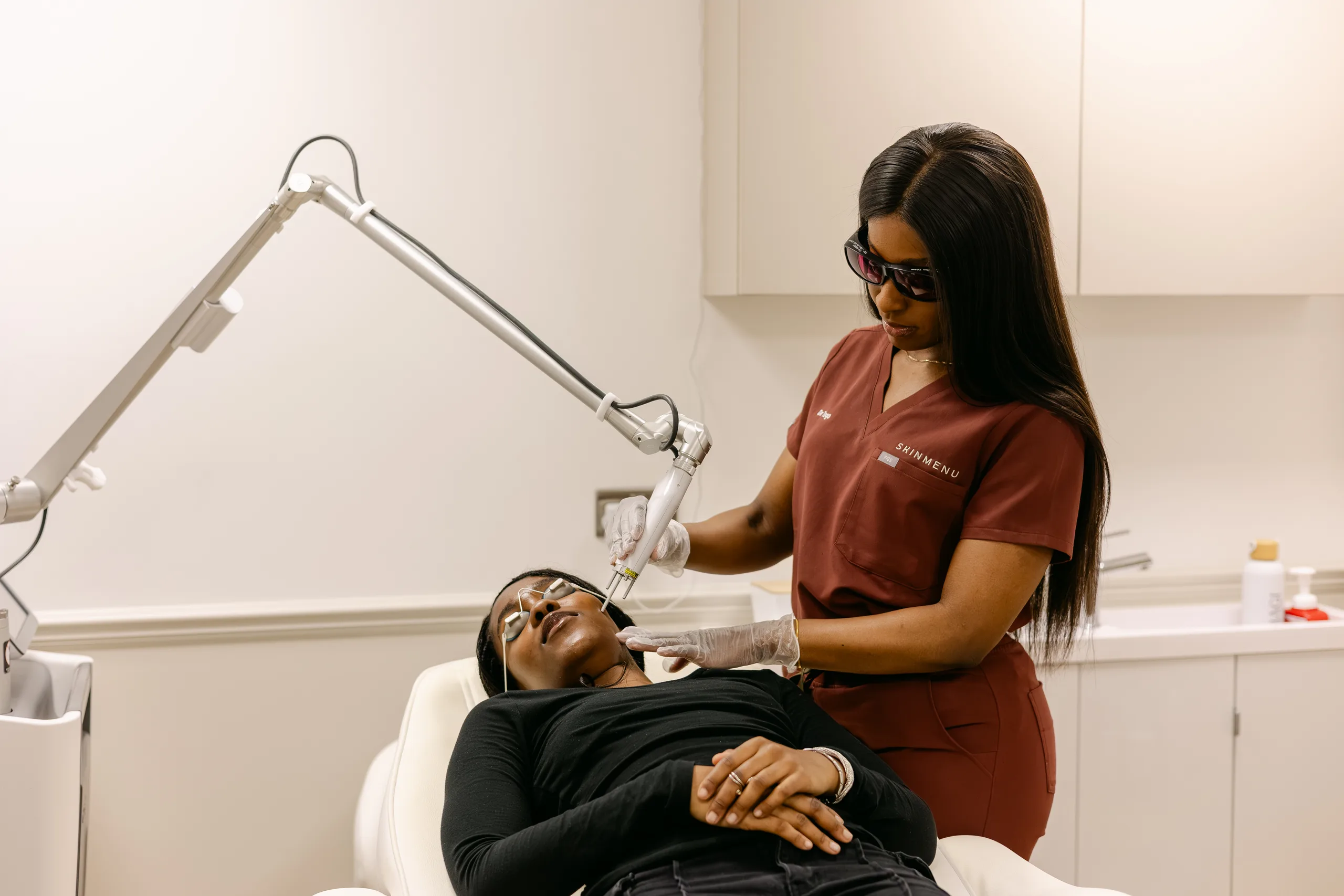
One of the most persistent myths in aesthetics is that laser treatments aren’t safe for darker skin.
The reality is more nuanced.
Many laser treatments can be performed safely in melanin-rich skin, but treating darker skin requires an understanding of how laser energy interacts with melanin, careful selection of the right technology and treatment parameters, and appropriate preparation before and after treatment.
The question isn’t simply “Is this laser safe for darker skin?”
It’s “Is this the right laser, with the right settings, for this skin?”
Why does skin tone matter with laser?
Lasers work by delivering energy at specific wavelengths, which are absorbed by particular targets within the skin. These targets are known as chromophores and include melanin, haemoglobin and water.
When we’re treating pigmentation, melanin may be exactly what we want the laser to target.
The challenge is that melanin isn’t only present in unwanted pigmentation. It is also naturally present within the epidermis, and darker skin contains more epidermal melanin.
This means there can be greater competition between the pigment we want to treat and the melanin we want to protect.
If too much laser energy is absorbed by the surrounding epidermis, excessive heat and inflammation can occur, increasing the risk of complications.
What are the risks?
One of the most important considerations when treating melanin-rich skin is post-inflammatory hyperpigmentation, or PIH.
PIH occurs when inflammation stimulates increased melanin production, leaving an area of skin darker after it heals.
Melanin-rich skin has a greater tendency to develop PIH, whether the original inflammation comes from acne, an injury or an aesthetic procedure.
Laser treatment can therefore create an interesting challenge: we may be using a laser to improve pigmentation, but an overly aggressive treatment can create inflammation that produces more pigmentation.
Other potential complications include burns, blistering, prolonged redness and, less commonly, hypopigmentation or scarring.
This doesn’t mean darker skin shouldn’t be treated. It means it needs to be treated appropriately.
There is no single “safe laser” for darker skin
You may have heard that certain lasers are “safe for all skin tones”.
We prefer to be more careful with that language.
Laser safety isn’t determined by the name of the machine alone.
The wavelength matters, but so do the fluence, pulse duration, spot size, treatment density, cooling, number of passes and the way those parameters interact with the individual patient’s skin.
The same device can potentially be used very differently by two practitioners.
This is why choosing an experienced practitioner matters just as much as choosing the technology.
Wavelength matters
Different wavelengths interact with melanin differently.
Shorter wavelengths generally have greater absorption by melanin, which can make them very effective for certain superficial pigment concerns but also means greater care may be required in darker skin.
Longer wavelengths, such as 1064 nm Nd:YAG, have lower absorption by epidermal melanin and penetrate more deeply into the skin. This is one reason 1064 nm technology is widely used when treating darker skin tones.
But wavelength alone doesn’t determine safety.
A 1064 nm laser can still cause complications if used incorrectly, while other wavelengths may be appropriate in carefully selected patients and indications.
The treatment needs to be considered as a whole.
The type of laser matters too
Not every laser is trying to achieve the same thing.
At SKINMENU, we use different laser technologies depending on what we’re treating.
Pico Laser delivers energy in extremely short pulses and can be used to target pigmentation as well as create a fractional effect within the skin.
Laser Genesis uses a 1064 nm Nd:YAG wavelength to gently heat the dermis and can be used to improve redness, inflammation and overall skin quality.
Cool Laser, our Erbium:YAG resurfacing treatment, targets water rather than melanin and allows controlled ablation of the skin with relatively limited residual thermal damage.
Even within one device, the way we use the technology can vary considerably depending on your skin tone, concern and treatment goal.
Why heat matters
When treating melanin-rich skin, managing unnecessary heat and inflammation is particularly important.
This doesn’t mean that heat is always bad. Many laser treatments rely on controlled thermal effects to create their result.
The goal is to deliver enough energy to achieve the desired clinical effect without creating excessive injury to the surrounding tissue.
More aggressive does not automatically mean more effective.
In some cases, trying to achieve a dramatic result in one session can create more inflammation and ultimately increase the risk of pigmentation.
A considered course of treatments can be safer and more effective than pushing the skin too far in a single appointment.
Skin preparation can be part of laser safety
Laser safety starts before the laser is switched on.
For patients prone to pigmentation, we may recommend a period of skin preparation before certain treatments.
This can include pigment-regulating ingredients that help reduce excessive melanin production and prepare the skin for the inflammatory response associated with treatment.
We also assess your current skincare, skin barrier, recent procedures and sun exposure.
If your skin is irritated, recently tanned or has had significant recent sun exposure, proceeding with laser may not be appropriate.
Sometimes the safest decision is to wait.
Sun exposure matters
Recent sun exposure can increase melanin activity within the skin, which can alter the way it responds to laser energy.
For this reason, we ask about recent holidays, tanning and significant sun exposure before treatment.
Sun protection is equally important afterwards.
Following laser, the skin can be more vulnerable to UV-induced pigmentation, making consistent broad-spectrum SPF an important part of your aftercare and longer-term results.
What about treating hyperpigmentation in darker skin?
Hyperpigmentation is one of the most common reasons patients with melanin-rich skin come to SKINMENU.
It is also one of the areas where careful diagnosis matters most.
Post-inflammatory hyperpigmentation, melasma, sun-induced pigmentation and other pigmentary conditions may look similar to an untrained eye, but they don’t necessarily behave in the same way or require the same treatment.
Before treating pigment with a laser, we need to understand what the pigment is, where it sits and why it developed.
Sometimes laser is appropriate.
Sometimes skincare or a chemical peel should come first.
And sometimes the safest option is not to laser the pigmentation at all.
Your skin tone is only part of the assessment
Two people with a similar skin tone can respond very differently to the same treatment.
We also consider your history of pigmentation, how your skin responds to inflammation, previous laser treatments, current skincare, medical history, recent sun exposure and the specific condition we’re treating.
This is why a consultation matters.
We aren’t treating a Fitzpatrick skin type or a shade on a chart. We’re treating your skin.
The SKINMENU approach to laser
At SKINMENU, laser treatment begins with assessment rather than choosing a machine.
We consider the concern we’re treating, the chromophore we need to target, your skin tone and pigmentation history, the appropriate wavelength and treatment parameters, and how we can minimise unnecessary inflammation.
For some patients, that means preparing the skin first. For others, it means choosing a different technology or building results gradually over several sessions.
Having melanin-rich skin doesn’t automatically mean laser is off limits.
But it does mean that the technology, the practitioner and the treatment plan matter.
Keep reading